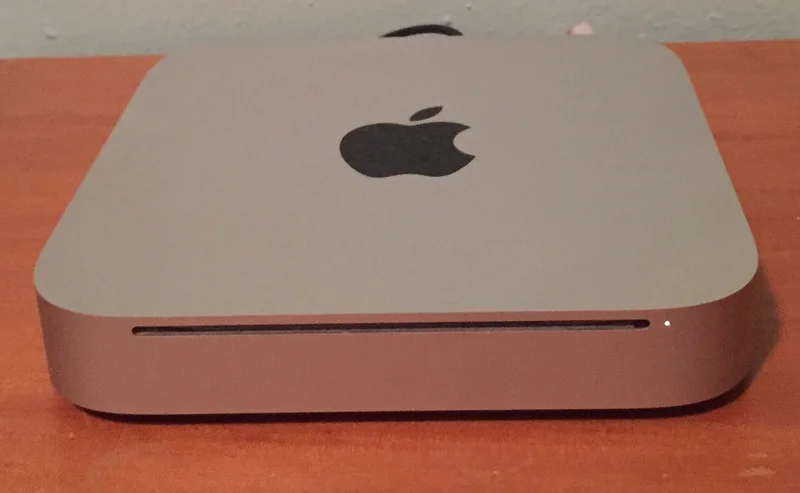
Mac mini (M4, 2024)
Dramatically smaller redesign. M4 at $599 entry price for the first time. New two-port front USB-C.
Apple shrank the mini to roughly the size of an Apple TV and put more power in it than ever. M4 and M4 Pro run efficiently enough that the internal volume could collapse dramatically, and the result is the smallest desktop Apple has shipped. Two ergonomic decisions stand out. Ports moved to the front, a USB-C connector and a headphone jack, which sounds trivial until you have spent twenty years reaching behind a desktop for a drive. The power button moved to the underside, which sounds like a mistake and mostly is not, though people did write about it. The M4 Pro configuration is the fastest mini Apple has made, handling work that needed a Mac Studio two years earlier, in a box smaller than most external drives from the previous decade. Reviewers were delighted and said so. The standing caveat remains, since memory and storage are fixed at purchase, so choose carefully. This is the mini as a serious machine again.
Mac History Timeline
Full Specifications
Availability
Processor
Memory
Storage
Display
Graphics
Expansion
Connectivity
Physical
Processor Deep Dive
Apple M4 / M4 Pro
AppleBuilt on an advanced second-generation 3nm process, M4 and M4 Pro brought faster CPU and GPU cores along with an even more capable Neural Engine tuned for on-device AI workloads, while drawing little enough power to allow this Mac mini's radically shrunken new enclosure. Against Intel Core Ultra and AMD Ryzen AI mobile and desktop chips of the era, the M4 family extended Apple Silicon's substantial efficiency and sustained-performance lead, particularly in machine-learning-accelerated tasks. M4 Pro's inclusion in a Mac mini this small represented a genuine engineering achievement, delivering near-Mac-Studio-class performance in a fraction of the volume.
Compatible Operating Systems

macOS Sequoia 15.1
Launch OS2024
Launched as the debut OS for the radically redesigned M4 Mac mini.
macOS Sequoia 15
Compatible2024
Continued to receive updates with expanding Apple Intelligence features.
macOS Sequoia 15
Compatible2025
Remains actively supported and updated as of the most recent macOS releases.
Reviews & Reception
The M4 Mac mini was celebrated as one of the most successful redesigns in the product's history, praised for its dramatically smaller size and thoughtful ergonomic improvements.
This is a genuinely stunning shrink, smaller than an Apple TV box, and Apple somehow made it more usable with front-facing ports at the same time.
The M4 Pro configuration brings near-Mac-Studio performance to a chassis this small, which is a genuinely impressive engineering feat.
Moving the power button to the bottom is a bold choice, but the front-facing USB-C port and headphone jack are exactly the ergonomic fixes long-time mini owners have wanted.
This might be the best Mac mini Apple has ever made, combining a radically smaller footprint with genuinely serious performance options.