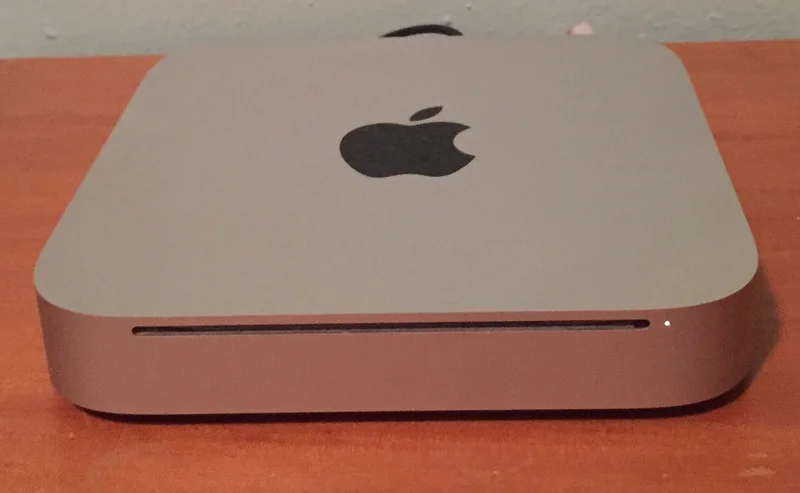
Mac mini (M1, 2020)
First M1 desktop. Massive leap in performance for its size and price. Ideal BYOD Mac.
The third of the first three Apple Silicon Macs, and the one developers bought in quantity. Same aluminum case since 2010, now only in silver rather than space gray, and the same M1 as the Air and the 13-inch Pro, which left the outgoing six-core Intel mini behind on nearly every benchmark while drawing far less power and running a smaller, quieter fan. For anyone building software it was close to ideal. Cheap, small, near-silent, and perfectly suited to testing native Apple Silicon builds or sitting on a shelf as a build machine or a home server. The limits were M1's limits. 16GB of memory at most, one external display, and two Thunderbolt ports where the Intel mini's higher configurations had four. M1 was designed for a laptop first, and it showed here. Anyone with two monitors or large datasets had good reason to wait for M1 Pro and Max, and everyone else got desktop performance that beat machines costing considerably more at the lowest price of entry Apple offered.
Mac History Timeline
Full Specifications
Availability
Processor
Memory
Storage
Display
Graphics
Expansion
Connectivity
Physical
Processor Deep Dive
Apple M1
AppleThe same 5nm, 8-core CPU and up to 8-core GPU unified-memory system-on-chip used across Apple's first Apple Silicon Mac lineup, here running in a compact desktop chassis with active cooling for sustained workloads. Its dramatic power efficiency compared to Intel's contemporary Coffee Lake desktop chips let Apple shrink the mini's thermal demands while still delivering a substantial multi-core performance leap over the outgoing Intel model. M1's desktop debut in the mini proved Apple's new architecture scaled cleanly beyond laptops, an important signal ahead of the more powerful Pro, Max, and Ultra variants to come.
Compatible Operating Systems

macOS Big Sur 11.0.1
Launch OS2020
Launched as the first macOS built to natively support Apple Silicon Macs.

macOS Monterey 12
Compatible2021
Brought Universal Control, letting this mini share a keyboard and mouse across Macs.

macOS Ventura 13
Compatible2022
Added Stage Manager and Continuity Camera support.

macOS Sonoma 14
Compatible2023
Continued full support with desktop widgets and gaming-focused improvements.

macOS Sequoia 15
Compatible2024
Brought several Apple Intelligence features to this original Apple Silicon mini.
macOS Sequoia 15
Compatible2025
Remains actively supported and updated as of the most recent macOS releases.
Reviews & Reception
The M1 Mac mini was celebrated as an outstanding value that proved Apple Silicon's efficiency and performance gains extended well beyond laptops.
This tiny box quietly outperforms Intel Mac minis costing much more, and it does it while barely making a sound. It's an incredible value for developers and tinkerers alike.
Single external display support feels like a real limitation for some setups, but for the vast majority of buyers the sheer performance-per-dollar here is remarkable.
The M1 Mac mini is proof that Apple's new chip isn't just a laptop trick. Desktop users get the same stunning efficiency and performance leap here.
At this price, with this performance, it's hard to recommend anything else as an entry point into the Mac ecosystem right now.