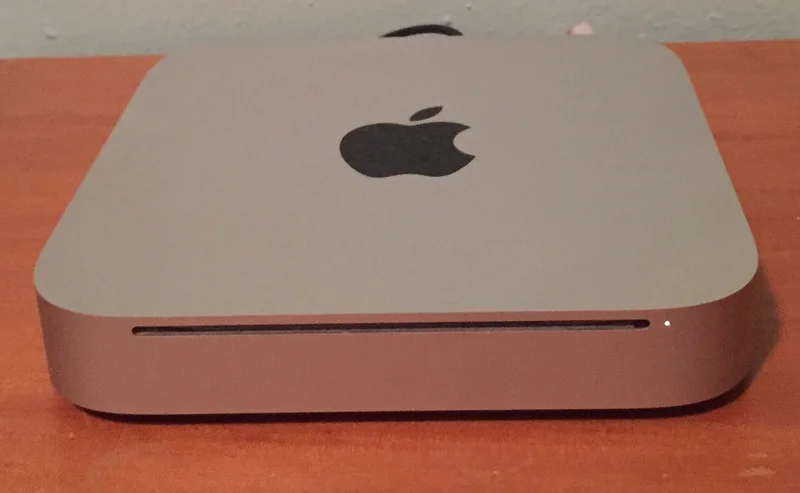
Mac mini (G4)
First Mac under $500. 'BYODKM' — Bring Your Own Display, Keyboard, Mouse. Tiny 6.5-inch square box.
Apple sold a Macintosh for under $500, which it had not done in living memory. The Mac mini arrived at Macworld in January 2005 alongside the iPod shuffle, six and a half inches square and two inches tall, with no display, keyboard or mouse in the box. Enthusiasts called it BYODKM. The pitch was aimed squarely at Windows users who already owned all three and wanted to try Mac OS X without buying everything twice. Inside was a PowerPC 7447A at 1.25 or 1.42GHz, modest against Pentium 4 and Athlon 64 desktops and entirely sufficient for web, email, iLife and everything else most people did in 2005. Mac OS X 10.3.7 was mature enough by then that the cheap Mac did not feel cheap. The price was the story. Macs had always carried a premium, and this one undercut budget Windows towers while keeping the design and the software. It was never for gaming or serious creative work, the integrated graphics saw to that, and opening the case required a putty knife and some nerve. A community formed around doing it anyway. Apple has been selling some version of this machine for twenty years since.
Mac History Timeline
Full Specifications
Availability
Processor
Memory
Storage
Display
Graphics
Expansion
Connectivity
Physical
Processor Deep Dive
PowerPC 7447A (G4)
FreescaleThe 7447A powered the original Mac mini at 1.25GHz or 1.42GHz, a mature, power-efficient G4 variant well suited to the tiny enclosure's limited thermal envelope. It retained AltiVec Velocity Engine support for accelerated media tasks, though its integrated graphics and modest clock speeds made it clearly a mainstream, non-gaming, non-professional chip. Compared to contemporary Pentium 4 and Celeron budget desktop chips, it offered adequate but unremarkable raw performance, with its real value proposition resting on Apple's software polish and the machine's astonishing size and price rather than benchmark leadership. It represented one of the final consumer applications of the G4 architecture before Apple's 2006 shift to Intel processors.
Compatible Operating Systems
Mac OS X 10.3.7 Panther
Launch OS2005
Shipped as the factory OS on the original Mac mini G4.

Mac OS X 10.4 Tiger
Compatible2005
Widely adopted update bringing Spotlight and Dashboard to the compact Mac mini.
Mac OS X 10.5 Leopard
Max Supported2007
Final PowerPC-compatible OS X release, fully supported on both Mac mini G4 clock-speed configurations.
Reviews & Reception
Praised widely for its unprecedented affordability and remarkably compact design, seen as an effective and welcoming entry point for new Mac users.
At this price, the Mac mini is nothing short of a landmark: a real, fully capable Mac that finally undercuts entry-level Windows PCs.
Tiny, quiet, and genuinely affordable, though the lack of a monitor, keyboard, and mouse in the box will surprise some first-time buyers.
Apple has built the perfect gateway drug for Windows switchers curious about the Mac. Performance is modest but perfectly adequate for everyday use.
The mini's size is almost unbelievable in person, and its limited internal expansion is a fair trade-off for what Apple is charging.