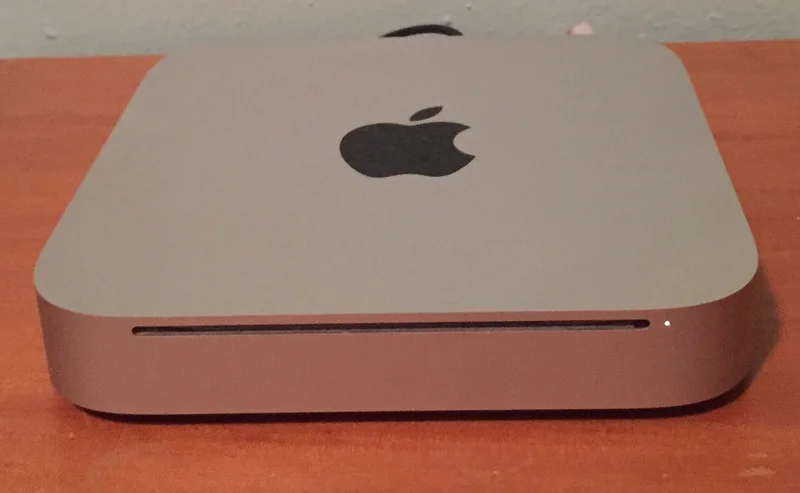
Mac mini (2018)
Long-awaited upgrade after 4 years. Space gray, T2 chip, configured for pro users.
Four years of silence, then a genuinely good machine. The 2018 mini was rebuilt properly. Quad-core and six-core Coffee Lake processors, up to 64GB of RAM, all-flash storage as standard, and a T2 chip handling encrypted storage and audio and image processing. Thunderbolt 3 replaced the aging ports, which mattered for external displays and fast storage. Space gray to match the iMac Pro, which was Apple's way of saying this was a tool again rather than the cheapest route into macOS. The RAM stayed soldered on most configurations, so the 2012 mini's twist-off panel remains a memory, though a far higher ceiling took some of the sting out provided you paid Apple's prices at the till. The entry price rose well above the $499 of 2014, in line with the new positioning. Reviewers were mostly relieved. Several called it the best mini Apple had made, and it put the product back in a position to matter just as Apple Silicon arrived, which the M1 mini proved two years later.
Mac History Timeline
Full Specifications
Availability
Processor
Memory
Storage
Display
Graphics
Expansion
Connectivity
Physical
Processor Deep Dive
Intel Core i3/i5/i7 (Coffee Lake)
IntelThese 14nm Coffee Lake chips brought genuine quad-core and 6-core options back to the Mac mini lineup for the first time since 2012, a major multi-threaded performance leap over the dual-core-only 2014 model. Against AMD's Ryzen desktop chips launching around the same period, Intel still held a slight per-core edge in many workloads, though AMD was beginning to offer more cores per dollar, intensifying competitive pressure. Clocked from roughly 3.2 to 3.6GHz depending on configuration, Coffee Lake gave this mini legitimate compute headroom for development, light server work, and creative tasks.
Compatible Operating Systems

macOS Mojave 10.14.1
Launch OS2018
Launched as the debut OS for the redesigned 2018 Mac mini.

macOS Catalina 10.15
Compatible2019
Continued official support with 64-bit-only application requirements.

macOS Big Sur 11
Compatible2020
Brought a major visual redesign that ran well on this Coffee Lake mini.

macOS Monterey 12
Compatible2021
Continued to receive full official Apple support three years after launch.

macOS Ventura 13
Compatible2022
One of the later releases still officially supporting this T2-equipped mini.

macOS Sonoma 14
Compatible2023
Continued official support five years after this model's debut.

macOS Sequoia 15
Max Supported2024
The final officially supported macOS release for the 2018 Mac mini.
Reviews & Reception
The 2018 Mac mini was warmly welcomed as a long-overdue, substantial upgrade that restored the product's credibility for developers and professionals.
This is the Mac mini update longtime fans have been begging for, finally treating the product like a serious machine again instead of an afterthought.
Quad-core and six-core options return, and the T2 chip brings real security improvements, though the soldered RAM and higher price will disappoint some old-school mini fans.
Four years was far too long to wait, but the wait clearly paid off. This is easily the most capable Mac mini Apple has ever shipped.
The higher starting price stings compared to the old $499 model, but the performance and connectivity gains here are substantial and genuinely overdue.