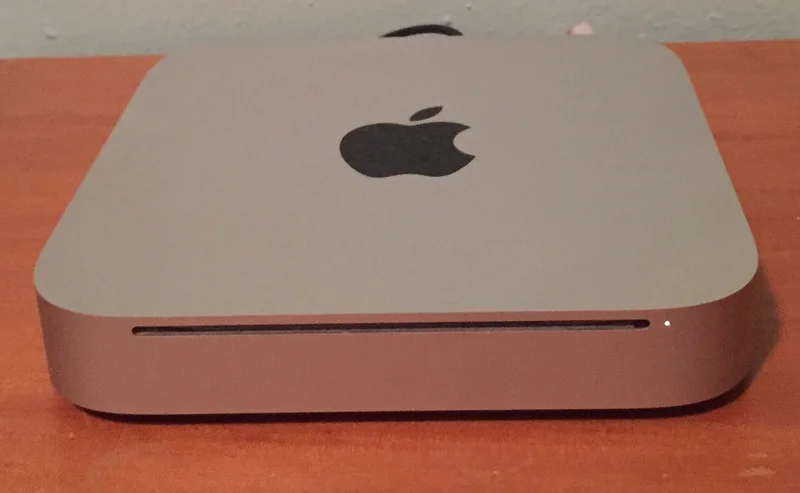
Mac mini (Late 2012)
USB 3 Mac mini. Good daily driver, last model with user-accessible RAM.
The Late 2012 mini is the one enthusiasts still recommend, because of a twist-off panel on the bottom. Behind it was the RAM. You could replace it in a minute, no tools. Apple soldered it shut two years later and removed the quad-core option at the same time, in a 2014 refresh people are still annoyed about, and that contrast is most of this machine's reputation. Ivy Bridge Core i5 or i7 at 2.5 to 2.6GHz, in the same aluminum enclosure since 2010, with USB 3.0 arriving at last after the mini's ports had fallen well behind contemporary PCs. A Server model carried two internal hard drives instead of an optical drive, aimed at small businesses and people running things at home. Apple dropped that configuration quietly in later years. Performance was a sensible step past the 2011 model and nothing more. Intel HD 4000 graphics on the low end were fine for everyday work and no use for games or serious creative work. It stayed the cheapest way into the Mac, and a lot of buyers took the base configuration and upgraded it themselves, which is exactly what Apple stopped allowing.
Mac History Timeline
Full Specifications
Availability
Processor
Memory
Storage
Display
Graphics
Expansion
Connectivity
Physical
Processor Deep Dive
Intel Core i5/i7 (Ivy Bridge)
IntelThese dual-core (i5/i7) and quad-core (i7 BTO) 22nm Ivy Bridge processors clocked at 2.5 to 2.6GHz brought efficient, cool-running performance well suited to the Mini's compact enclosure. Against AMD's contemporaneous APUs, Intel offered clearly superior single-thread performance, though weaker integrated graphics than AMD's Radeon-based solutions. Ivy Bridge's refined 22nm tri-gate transistors allowed Apple to keep the Mini fanless-quiet even under sustained load.
Compatible Operating Systems
OS X Mountain Lion 10.8.2
Launch OS2012
The Late 2012 Mac mini launched running Mountain Lion out of the box.

OS X Mavericks 10.9
Compatible2013
Delivered under Apple's new free annual OS X update policy.
OS X Yosemite 10.10
Compatible2014
Brought a flat redesign that ran smoothly on this Ivy Bridge hardware.

macOS Sierra 10.12
Compatible2016
Continued to receive full official Apple support four years after launch.

macOS High Sierra 10.13
Compatible2017
Supported APFS conversion for this model's SSD and hybrid configurations.

macOS Mojave 10.14
Compatible2018
One of the last major releases to officially support this generation.

macOS Catalina 10.15
Max Supported2019
The final officially supported macOS release for the Late 2012 Mac mini.
Reviews & Reception
The 2012 Mac mini was well received for its added USB 3.0 support, continued RAM upgradeability, and strong value, with graphics performance as the main knock.
USB 3.0 finally arrives on the Mac mini, and it's about time. This remains the most affordable and flexible entry point into the Mac ecosystem.
The Mini's easily accessible RAM door is a small thing that makes a big difference for anyone who wants to upgrade down the road without paying Apple's markup.
It's not an exciting update on paper, but the combination of USB 3.0, quad-core options, and continued affordability makes this the mini to beat.
Integrated graphics remain this machine's weak point, but for everyday computing and light server duty, the 2012 mini punches well above its price.