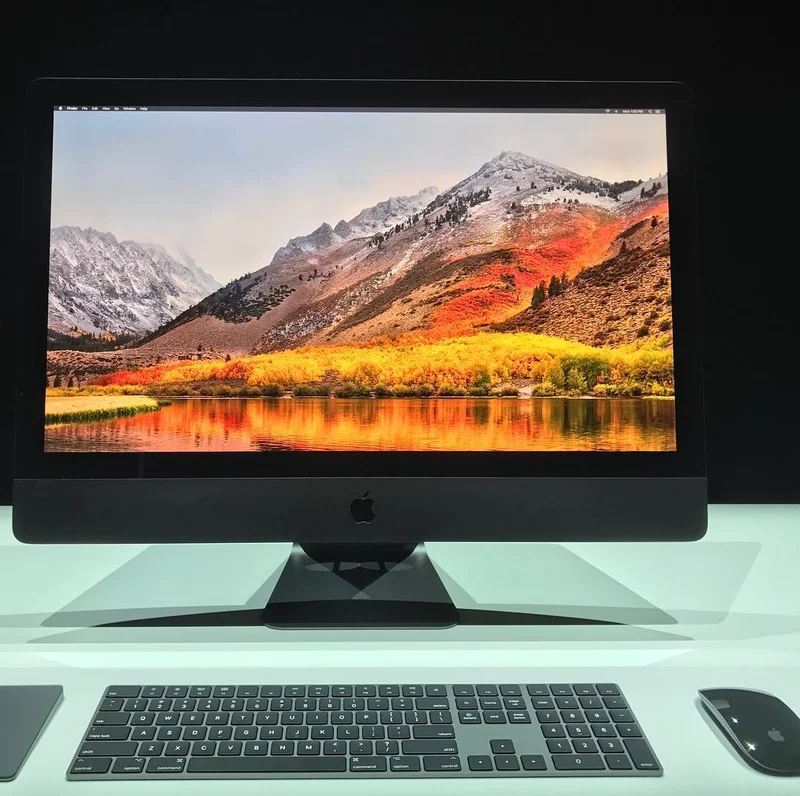
iMac Pro (2017)
Apple's most powerful all-in-one. Space gray finish for pro video, 3D, and music professionals.
Space gray, and the fastest Mac Apple had ever sold. Xeon W processors from 8 to 18 cores, AMD Radeon Vega Pro graphics and up to 128GB of ECC memory, inside the 27-inch Retina 5K chassis with an entirely new thermal architecture built to keep workstation silicon cool in an all-in-one. The T2 security chip debuted in an iMac here, handling encrypted storage, the always-on Siri listening and camera image processing. Timing explains a lot of it. The cylindrical Mac Pro had been sitting without an update for four years, and professionals treated the iMac Pro as the stopgap, then discovered it was often the better machine. Reviewers were impressed by benchmarks matching tower workstations that cost considerably more, and clear-eyed that a sealed all-in-one cannot take a new graphics card in three years when the work gets heavier. The space gray finish, with matching keyboard, mouse and trackpad, became an object people wanted regardless of whether they needed 18 cores. Apple discontinued it in 2021 with no successor, because Apple Silicon and the Mac Studio had made a Xeon all-in-one unnecessary.
Mac History Timeline
Full Specifications
Availability
Processor
Memory
Storage
Display
Graphics
Expansion
Connectivity
Physical
Processor Deep Dive
Intel Xeon W
IntelThese workstation-grade Skylake-based Xeon W chips scaled from 8 to 18 cores with ECC memory support, targeting sustained multi-threaded professional workloads rather than peak single-core speed. Compared to AMD's Ryzen and Threadripper chips emerging around the same time, Intel's Xeon W offered mature ECC and workstation validation but at a real cost and power premium, an area AMD would soon begin seriously contesting. Clocked from 3.2 to 4.5GHz depending on core count, these chips gave the iMac Pro genuine rendering and compute performance competitive with dedicated tower workstations.
Compatible Operating Systems

macOS High Sierra 10.13.2
Launch OS2017
Launched as the debut OS for the iMac Pro, including T2 chip support.

macOS Mojave 10.14
Compatible2018
Added Dark Mode and improved Metal 2 support for the Vega Pro GPUs.

macOS Catalina 10.15
Compatible2019
Continued official support with 64-bit-only app requirements.

macOS Big Sur 11
Compatible2020
Brought a major visual redesign that ran smoothly on this workstation-class hardware.

macOS Monterey 12
Compatible2021
Released the same year Apple quietly discontinued the iMac Pro.

macOS Ventura 13
Compatible2022
One of the later releases still officially supporting the T2-equipped iMac Pro.

macOS Sonoma 14
Max Supported2023
The final officially supported macOS release for the iMac Pro.
Reviews & Reception
The iMac Pro was widely praised as an extraordinarily powerful all-in-one workstation, with its only real knock being the inherent lack of internal expandability.
This is the most powerful Mac Apple has ever made, and in an all-in-one chassis no less. Benchmark numbers here go toe to toe with dedicated tower workstations.
The space gray finish looks phenomenal, and the performance for video and 3D work is genuinely impressive, but the sealed, non-upgradeable design is a real tradeoff for a machine this expensive.
For creative professionals stuck waiting on a new Mac Pro, the iMac Pro is a remarkably capable stand-in, even if it can't be expanded down the road.
Apple built an absolute beast of a machine here, quietly filling the void left by the aging Mac Pro while its higher-end customers waited for an actual answer.