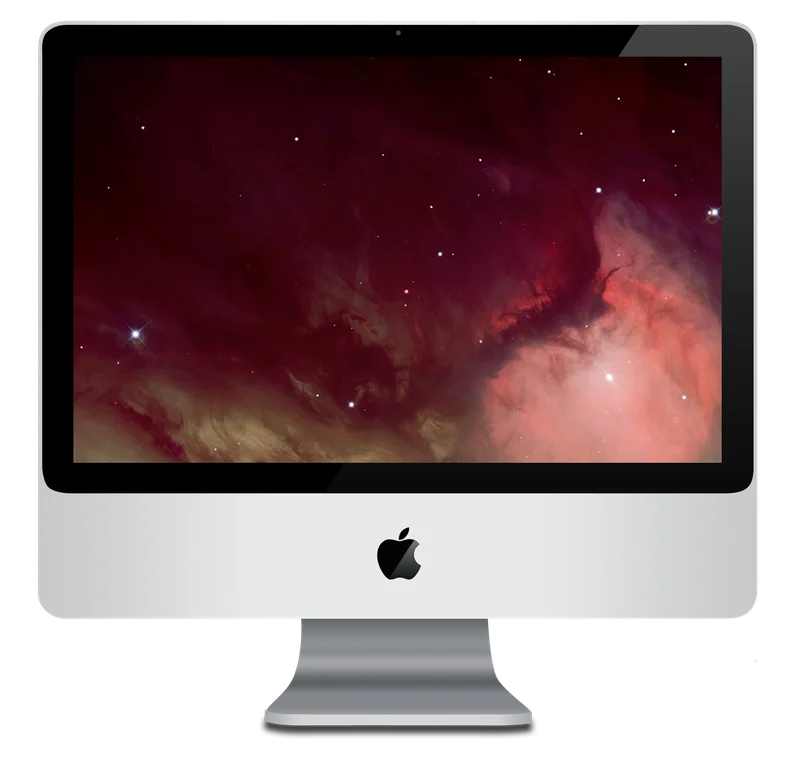
iMac (Early 2006)
First Intel iMac, launching Apple's historic transition from PowerPC. Nearly identical design to the G5.
On January 10, 2006 Jobs announced the iMac now ran Intel, and Apple's biggest hardware gamble was underway. The machine looked identical to the G5 it replaced. Same white polycarbonate, same aluminum foot, everything behind it new. An Intel Core Duo at up to 2.0GHz, the same Yonah mobile part in contemporary laptops, chosen for performance per watt rather than raw desktop power. Apple claimed two to three times the speed of the G5 iMac and independent testing broadly agreed, particularly on multitasking and on anything written to use two cores. Mac OS X 10.4.4 Tiger shipped in an x86 build, with Rosetta translating PowerPC software on the fly. It worked. It was also noticeably slower than native code, which is the compromise every such transition makes. Reviewers were impressed and buyers were nervous, because nobody knew how fast Universal Binary software would arrive, and it arrived within the year with Adobe and Microsoft among the first. The reason for all of it was simple. IBM had promised a 3GHz G5 and never delivered one, and the chip never fitted in a laptop at all. Eleven months later the entire Mac line ran Intel.
Mac History Timeline
Full Specifications
Availability
Processor
Memory
Storage
Display
Graphics
Expansion
Connectivity
Physical
Processor Deep Dive
Intel Core Duo (Yonah)
IntelCore Duo, codenamed Yonah, was Intel's first mainstream mobile dual-core processor and the chip Apple chose to launch its historic PowerPC-to-Intel transition. Built on a 65nm process, it offered dramatically better performance-per-watt than the PowerPC G4 and G5 chips it replaced, though it was 32-bit only and lacked EM64T support, which later capped its OS compatibility. It was competitive with AMD's Turion X2 mobile chips of the era but Intel's platform advantages and roadmap ultimately proved decisive for Apple. Its legacy is defined less by raw performance than by being the literal foundation of the Intel Mac era.
Compatible Operating Systems

Mac OS X 10.4 Tiger
Launch OS2006
Shipped with a special x86-native build of Tiger, 10.4.4 or later.
Mac OS X 10.5 Leopard
Compatible2007
Ran well and added Intel-native Time Machine and Spaces.
Mac OS X 10.6 Snow Leopard
Max Supported2009
Final supported OS, since Core Duo's 32-bit-only design excluded it from Lion's 64-bit kernel requirements.
Reviews & Reception
Widely praised as a technically impressive and historically significant leap, tempered by early Rosetta software growing pains.
The new iMac looks exactly like the old one, but under the hood it's a completely different machine, and a startlingly fast one at that.
Apple has managed the improbable: an architecture switch that mostly just works, though Rosetta-translated apps remind you this is still a transition in progress.
Benchmarks show real, substantial gains over the G5 iMac, but buyers should know they're early adopters of a platform still finding its native software legs.
For the first time in years, a Mac desktop can credibly claim performance parity with similarly priced Windows machines.