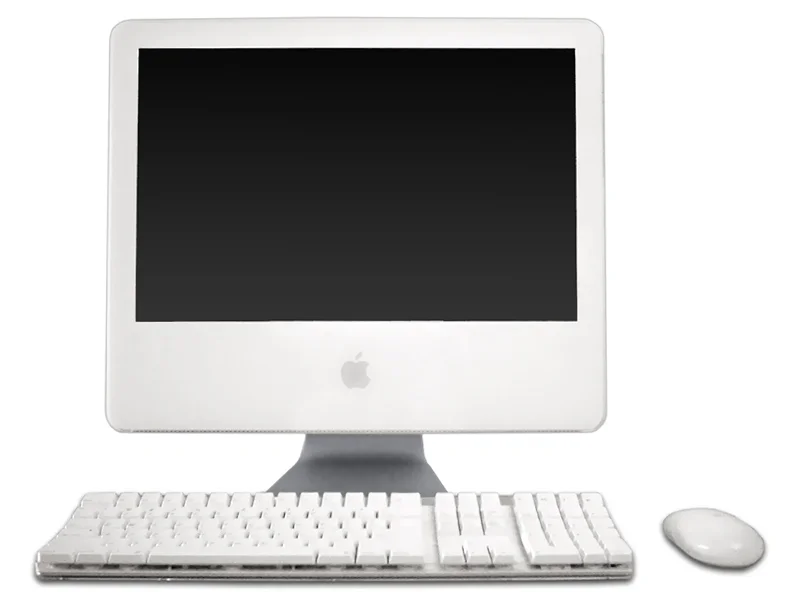
iMac G5
Revolutionary design putting all components behind the display. Predicted the modern all-in-one.
Apple put the entire computer behind the screen, and every iMac since has done the same. August 2004. Logic board, PowerPC 970FX, optical drive and everything supporting them sat in a white polycarbonate slab two inches thick on an aluminum foot, so from the front there was a display and nothing else. The processor was the same 64-bit chip as the Power Mac G5, running 1.6 to 2.1GHz. That put workstation-class silicon in a consumer all-in-one for the first time, against Pentium 4 and Athlon 64 desktops that still needed a tower and a separate monitor on the desk. Mac OS X 10.3.5 shipped on it, and iTunes, iPhoto and iMovie were reaching ordinary households at exactly that moment, which made this the obvious machine to recommend for photographs and home video. Fitting a 64-bit desktop chip into that depth without exotic cooling impressed reviewers. Some early units ran hot, and certain manufacturing batches had capacitor failures serious enough that Apple set up a repair program. It sold extremely well during the iPod years, when a lot of Windows users were looking at Macs for the first time. The lamp iMac is the one people remember. This is the one Apple is still building.
Mac History Timeline
Full Specifications
Availability
Processor
Memory
Storage
Display
Graphics
Expansion
Connectivity
Physical
Processor Deep Dive
PowerPC 970FX (G5)
IBMThe 970FX brought the 64-bit PowerPC G5 architecture, previously exclusive to the Power Mac tower, into a slim consumer all-in-one for the first time, clocked between 1.6GHz and 2.1GHz across iMac G5 revisions. Built on a more efficient 90-nanometer process than the original 970, it ran cooler and consumed less power, making it feasible to fit behind a thin LCD display without exotic cooling. Compared to contemporary Pentium 4 desktops, it offered strong floating-point and multimedia performance in a dramatically more compact and power-conscious footprint. Its presence in a mainstream consumer product signaled Apple's confidence in extending workstation-class architecture to everyday users.
Compatible Operating Systems
Mac OS X 10.3.5 Panther
Launch OS2004
Shipped as the factory OS on the original iMac G5 models.

Mac OS X 10.4 Tiger
Compatible2005
Broadly adopted, improving performance and adding Spotlight search to the iMac G5 experience.
Mac OS X 10.5 Leopard
Max Supported2007
Final PowerPC-compatible OS X release, fully supported across all iMac G5 configurations.
Reviews & Reception
Widely praised as a revolutionary, forward-looking design that brought 64-bit power to a stunningly thin all-in-one, with only isolated concerns about early reliability.
Apple has done the impossible again, fitting a genuine 64-bit desktop processor behind a two-inch-thick display. This is the future of the all-in-one computer.
Impossibly thin, remarkably powerful, and quietly revolutionary. This design will be copied for years.
A fantastic all-around machine, though some early units have shown concerning heat-related reliability issues worth watching.
The iMac G5 makes most Windows all-in-ones look like relics. A genuinely desirable computer for the mainstream buyer.