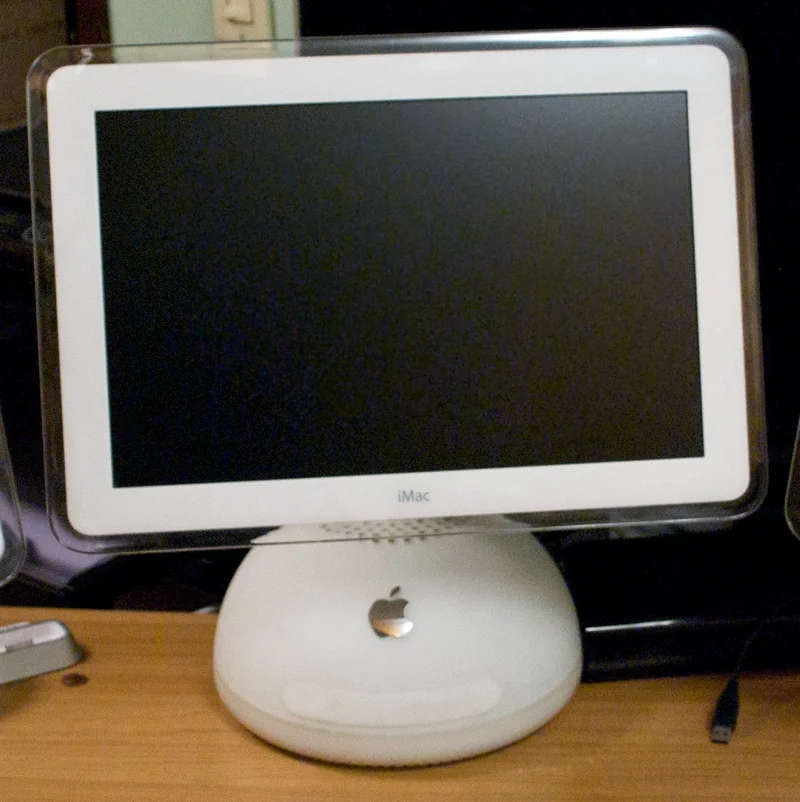
iMac G4 (Lamp)
Iconic 'Lamp' design with flat panel LCD on an articulated arm. A design masterpiece by Jonathan Ive.
A hemispherical dome with a flat LCD panel mounted on a chrome arm, shown in January 2002 and resembling nothing else anybody sold. Everyone called it the lamp, or the sunflower, and the Luxo Jr. comparison was obvious enough that Apple never had to make it. Jony Ive's team designed it after the Cube failed, which gives you some idea of the confidence in the building at the time. The arm was not decoration. It tilted, swiveled and pivoted well enough that you could set screen height and angle properly, which no other flat panel of the period allowed, and Apple's advertising leaned on it heavily. Inside was a G4 from 700MHz at launch to 1.25GHz later. Pentium 4 desktops posted bigger clock numbers and came in beige boxes with a separate monitor and a tangle of cables. Mac OS X 10.1.2 shipped on it, at exactly the moment Apple needed people to leave Mac OS 9 behind, and a friendly machine made an unfamiliar operating system easier to accept. Nothing has used the dome and arm since. The idea underneath, that a computer can be a sculpture you keep on a desk, went into the iMac G5 and everything after it.
Mac History Timeline
Full Specifications
Availability
Processor
Memory
Storage
Display
Graphics
Expansion
Connectivity
Physical
Processor Deep Dive
PowerPC 7441/7445 (G4)
Motorola/FreescaleThe 7441 and later 7445 G4 chips powered the iMac G4 at clock speeds from 700MHz up to 1.25GHz across its production run, carrying the AltiVec Velocity Engine for accelerated multimedia tasks like iMovie editing and iTunes encoding. These chips balanced power efficiency against the compact dome enclosure's limited cooling, making them well suited to a fanless-adjacent, consumer-friendly design. Against contemporary Pentium 4 desktops running at much higher clock speeds, the G4 traded raw throughput for efficient vector processing and lower heat output. The chip family reflected Motorola's, and later Freescale's post-spinoff, continued refinement of the G4 core for mainstream consumer machines.
Compatible Operating Systems

Mac OS X 10.1.2
Launch OS2002
Shipped as the factory operating system on the first iMac G4 models.
Mac OS X 10.2 Jaguar
Compatible2002
Widely adopted update that improved performance and added Quartz Extreme graphics acceleration.
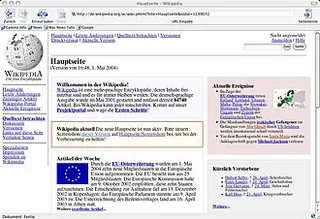
Mac OS X 10.3 Panther
Compatible2003
Ran well on the higher-clocked 800MHz-1.25GHz iMac G4 revisions.

Mac OS X 10.4 Tiger
Compatible2005
Supported on faster iMac G4 configurations with adequate RAM.
Mac OS X 10.5 Leopard
Max Supported2007
Only iMac G4 models at 867MHz or faster meet Leopard's minimum processor requirement.
Reviews & Reception
Near-universal critical acclaim for its groundbreaking dome-and-arm design, widely regarded as one of Apple's finest industrial design achievements.
Apple has once again reinvented what a personal computer can look like. The articulated arm is not just beautiful, it is genuinely useful.
Part desk lamp, part sculpture, entirely brilliant. This is industrial design at its most confident.
Performance is solid for everyday tasks, though Pentium 4 machines remain faster on paper. Nobody buys this iMac for benchmarks, though.
Even confirmed Windows users will admit this is one of the most striking computers ever built.