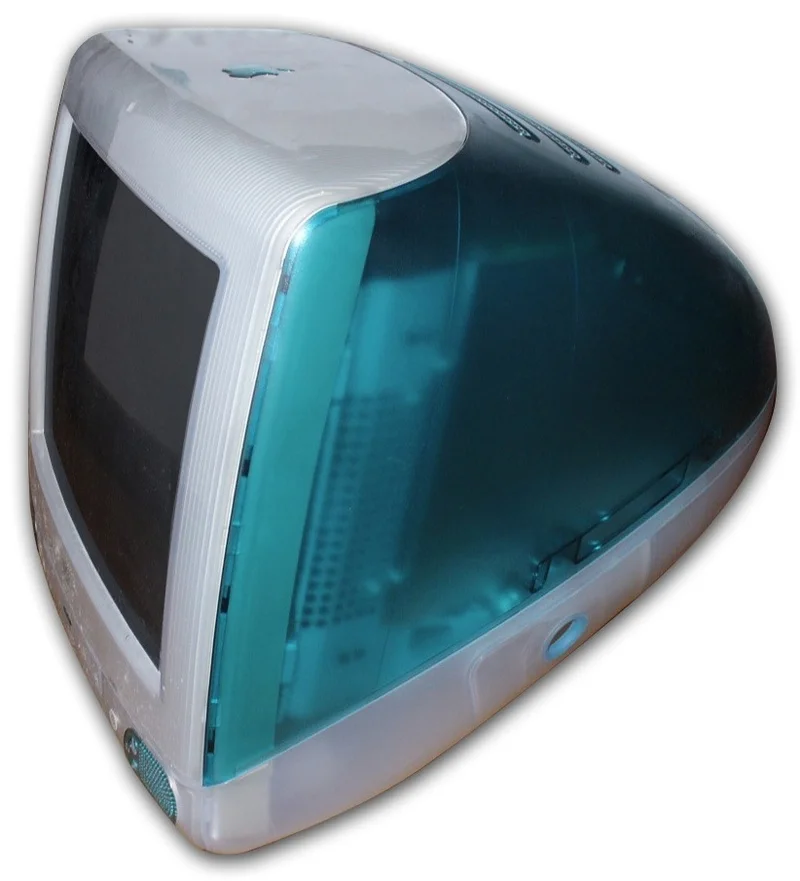
iMac G3 (Bondi Blue)
Steve Jobs' comeback machine. Revolutionary translucent design and simplified all-in-one form factor. Defined the late-90s Mac.
August 15, 1998. A translucent blue-green egg with a handle on top, no floppy drive, and one kind of port. Jony Ive designed the shell and Jobs approved it, and between them they ended fifteen years of beige. Inside was a 233MHz G3 running Mac OS 8.1, so it had the same speed advantage over a Pentium II that the Beige G3 had, in a package that needed one cable and no assembly. The controversial part was USB. Apple dropped ADB, dropped SCSI and dropped the floppy entirely, and a lot of people said so loudly. Critics predicted it would fail. It sold enormously instead. Peripheral makers rushed out USB devices for the iMac's new audience, which is most of why USB took over the PC industry as quickly as it did, and the floppy died years earlier than it otherwise would have. Reviewers split on the looks. Some thought it playful and some thought it a gimmick, and the argument itself generated more coverage than either verdict. It gave Apple its first properly profitable year in a long time. Everything from the fruit-colored iMacs to the Blue and White G3 came out of it.
Mac History Timeline
Full Specifications
Availability
Processor
Memory
Storage
Display
Graphics
Expansion
Connectivity
Physical
Processor Deep Dive
PowerPC 750 (G3)
IBM/MotorolaThe PowerPC 750, Apple's G3 chip, powered the original iMac at 233MHz, bringing the same efficient short pipeline and large cache design that had already embarrassed Intel's Pentium II in desktop benchmarks into an approachable consumer machine. Its strong per-clock performance let Apple market the iMac as both stylish and genuinely fast, a rare combination for a mainstream consumer computer in 1998. The chip's efficiency and manageable thermal output also suited the iMac's compact all-in-one enclosure well, requiring no complex cooling solution.
Compatible Operating Systems
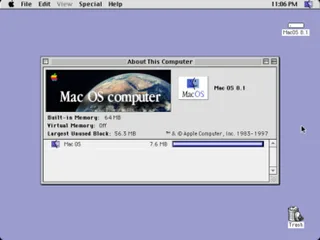
Mac OS 8.1
Launch OS1998
Shipped standard on the original Bondi Blue iMac.
Mac OS 8.5
Compatible1998
Brought Sherlock search and general performance refinements shortly after launch.
Mac OS 8.6
Compatible1999
Popular stable update widely installed on original iMacs.
Mac OS 9.2.2
Max Supported2001
The officially supported ceiling for the original iMac's New World ROM architecture.

Mac OS X 10.2 Jaguar
Compatible2002
Could run natively thanks to New World ROM support, though performance was noticeably strained on the original 233MHz processor.
Reviews & Reception
The original iMac generated intense, polarized debate over its design and missing floppy drive, but became a runaway commercial and critical success that is widely credited with saving Apple.
The iMac is unlike anything on the market: translucent, friendly, and fast, it feels like Apple has reinvented what a consumer computer can be.
Bondi Blue plastic and a single power cord have never looked so revolutionary; this is Steve Jobs announcing that Apple's design era has arrived.
Dropping the floppy drive and legacy ports entirely is a bold, even reckless bet; only time will tell if consumers accept USB-only connectivity.
Whatever one thinks of the styling, the underlying G3 performance and rock-bottom setup complexity make the iMac a genuinely compelling machine for first-time buyers.