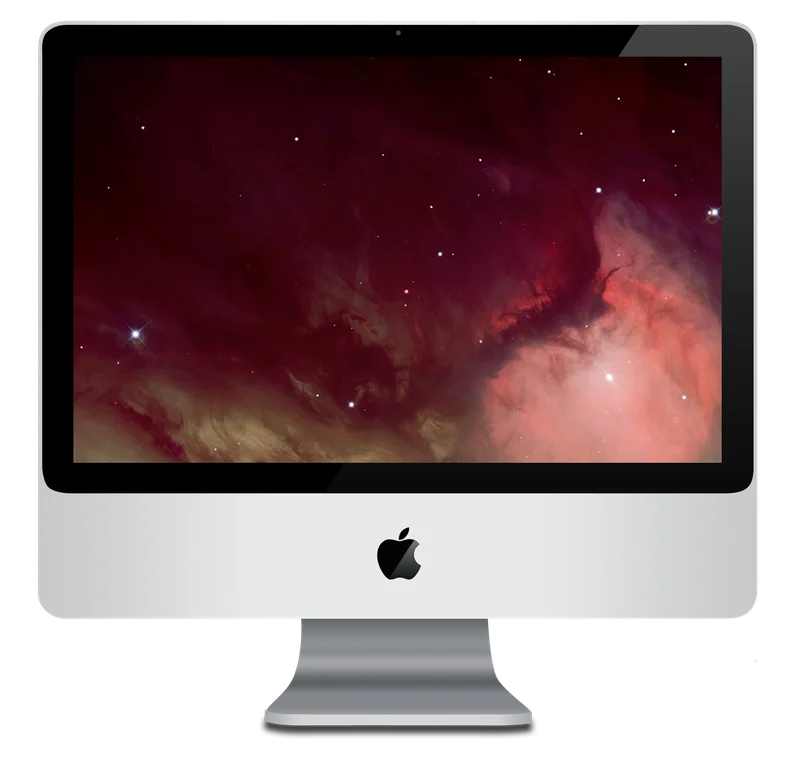
iMac (Mid 2007)
New aluminum and glass design replacing the white plastic. Thinner and more attractive.
Apple put the iMac in aluminum and glass in August 2007. It has looked broadly like that ever since. The white polycarbonate and clear plastic had run since 2002 and was starting to look like a leftover from the iMac G3 era. What replaced it was an anodized aluminum enclosure, edge-to-edge glass over the display, a slimmer profile, a new aluminum keyboard and a revised Mighty Mouse. Core 2 Duo processors from 2.0 to 2.8GHz gave enough headroom for iLife '08, which had just rebuilt iMovie, and for the increasingly heavy interface in Mac OS X. Reviewers liked the look almost without exception, reading it as a return to Apple's minimalist register after several playful years. The glass was the complaint. Reflections under bright light or sunlight annoyed photographers and editors constantly, and professional users kept saying so for years while buying them anyway. Aluminum chassis, glass front, tapering profile. Apple iterated on that with small changes through 2009 and onward, until the M1 iMac finally broke it in 2021. This is where the iMac stopped being a colorful appliance and started being the machine people picture.
Mac History Timeline
Full Specifications
Availability
Processor
Memory
Storage
Display
Graphics
Expansion
Connectivity
Physical
Processor Deep Dive
Intel Core 2 Duo (Merom/Conroe-derived mobile)
IntelThe 2007 iMac used Intel's Core 2 Duo, the 64-bit-capable successor to Core Duo, built on the same Core microarchitecture that had reinvigorated Intel's competitiveness against AMD. It offered meaningfully improved integer and floating-point performance alongside 64-bit computing support, a critical feature that extended this iMac's later operating system compatibility well beyond Core Duo-based machines. Compared to AMD's Athlon 64 X2 desktop chips of the period, Core 2 Duo generally held a clear efficiency and performance lead. Its 64-bit support made this generation a meaningfully more durable long-term purchase than the original 2006 Intel iMac.
Compatible Operating Systems

Mac OS X 10.4 Tiger
Launch OS2007
Shipped with Tiger 10.4.10.
Mac OS X 10.5 Leopard
Compatible2007
Widely used update that took advantage of the aluminum iMac's improved graphics.
Mac OS X 10.6 Snow Leopard
Compatible2009
Ran well thanks to 64-bit Core 2 Duo support.

Mac OS X 10.7 Lion
Compatible2011
Officially supported on most configurations of this model.
OS X 10.11 El Capitan
Max Supported2015
Widely regarded as the practical maximum for this generation depending on exact GPU configuration.
Reviews & Reception
Celebrated as a landmark design refresh, with glossy-screen glare as the main recurring criticism.
This is the biggest visual overhaul of the iMac since its debut, and it finally looks as premium as it costs.
The aluminum and glass design is gorgeous, though the glossy screen introduces glare issues serious users will want to consider.
A genuinely elegant all-in-one that leaves Dell's and HP's competing desktops looking cheap by comparison.
Reflections aside, this is the iMac finally growing into the design language Apple had been building toward for years.