iPhone
The original iPhone. Capacitive multi-touch, no keyboard, no App Store and no 3G, sold on a two-year AT&T contract.
Released June 29, 2007 · Discontinued July 15, 2008 · From $499 (4 GB, with contract)
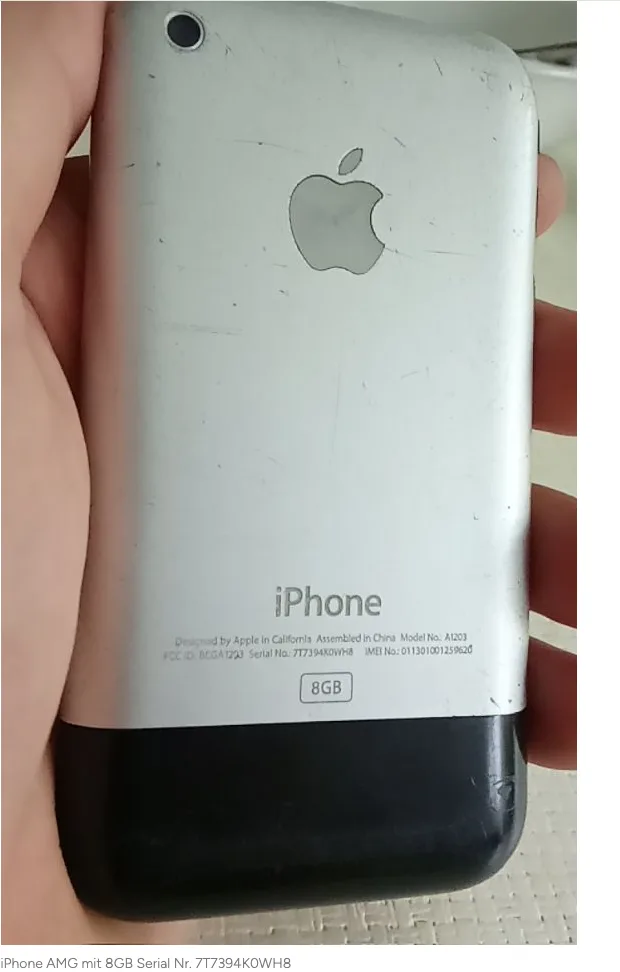
Steve Jobs stood on stage at Macworld on January 9, 2007 and said Apple was introducing three products: a widescreen iPod with touch controls, a revolutionary mobile phone, and a breakthrough internet communicator. Then he repeated the list until the room worked out it was one device. It went on sale June 29 that year. People queued for days. What they got was a 3.5-inch 320x480 screen at 163 pixels per inch, a 2-megapixel camera that could not record video, and a phone stuck on EDGE at a moment when rivals were already selling 3G. There was no App Store. Apple's answer to third-party software was to write web apps, which went down badly enough that the company reversed itself within a year. Capacitive multi-touch, no stylus, no plastic keyboard, and a rubber-band scroll that made the thing feel like it had physics. Inertial scrolling and pinch-to-zoom did more to sell the phone than any spec on the box. Underneath sat a 620MHz ARM11 clocked down to 412MHz and 128MB of RAM, which Apple traded against battery life rather than benchmarks. At $499 for 4GB and $599 for 8GB on a two-year AT&T contract it cost roughly double what a smartphone cost in 2007, which is why Apple cut the price by $200 two months later and refunded early buyers $100 in store credit. Apple sold around 6.1 million before discontinuing it in July 2008. The App Store arrived a year later and settled what the phone was actually for.
Reviews & Reception
The four reviewers Apple gave early units to broadly agreed the software set a new standard, and were equally direct about the EDGE network, the missing features and the AT&T exclusivity.
the iPhone is, on balance, a beautiful and breakthrough handheld computer
Its software, especially, sets a new bar for the smart-phone industry